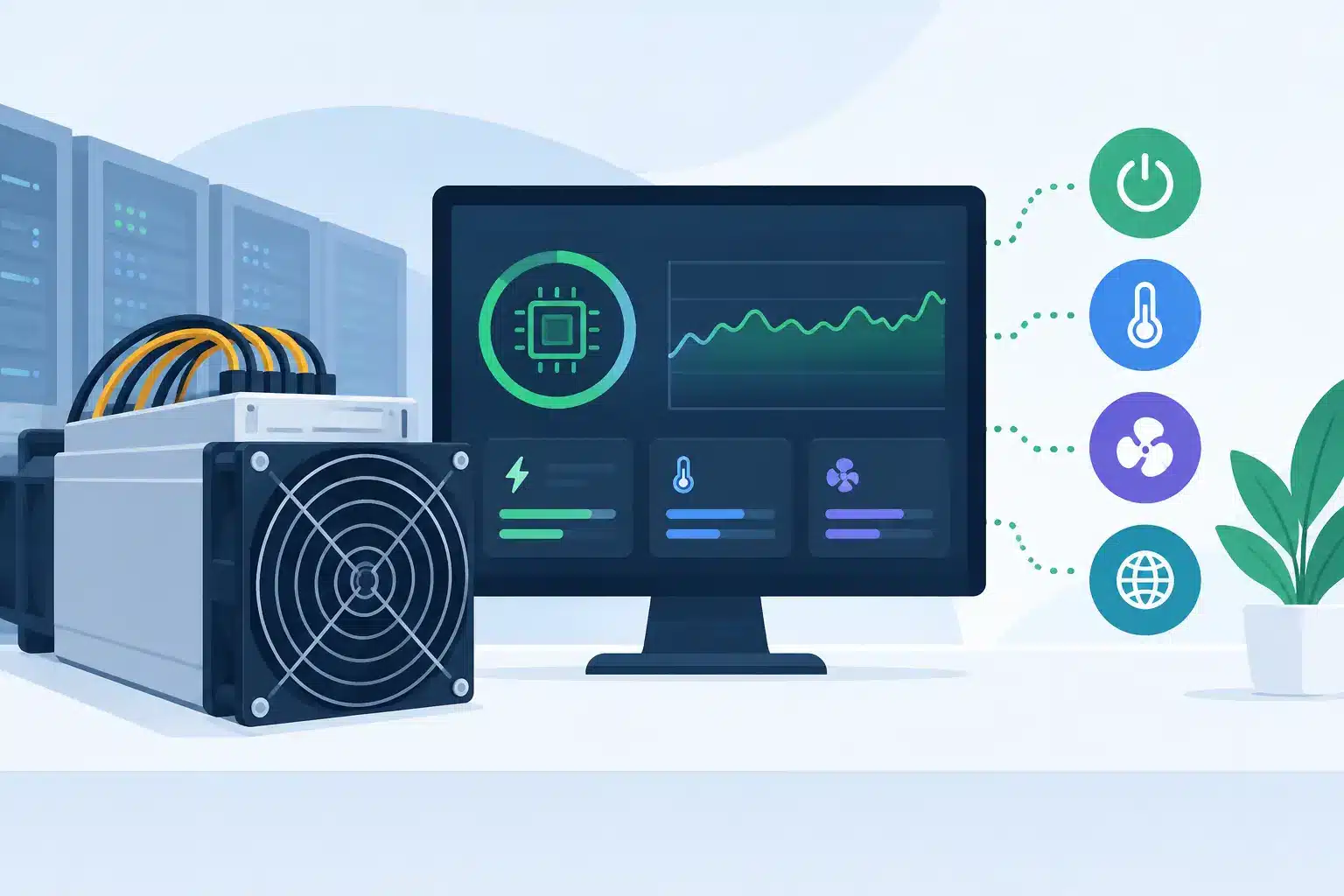
A miner can appear online while quietly losing money. A degraded fan, unstable pool connection, thermal throttling or a power supply operating outside its normal range may reduce hashrate long before a machine goes fully offline. An ASIC uptime monitoring system gives operators the visibility to catch these losses early, protect productive hours and keep maintenance decisions tied to real data rather than guesswork.
For a solo miner, that visibility may mean knowing why one machine is producing less than expected. For a fleet operator, it is how a site team prevents a small fault from becoming a row-level or facility-wide issue. Uptime is not simply a percentage on a dashboard. It is the operational discipline behind predictable mining output.
Why uptime is more than an online status
A basic online or offline signal is useful, but it is not enough to manage mining performance. An ASIC may be connected to the network and still underperform because one hashboard is missing, a chip temperature is too high, the fan speed is abnormal or the unit is repeatedly restarting. If the monitoring platform only reports connectivity, the operator learns about the fault after valuable hashrate has already been lost.
The more meaningful measure is effective uptime: the proportion of time a miner produces close to its expected hashrate under the intended power and cooling conditions. This requires comparing real performance against the machine model, selected operating mode and local environment. A 200 TH/s miner running steadily at 150 TH/s is not delivering full uptime from a commercial perspective, even if its IP address responds.
This distinction matters most when margins tighten. Electricity cost, pool fees and capital expenditure do not pause because a miner is partially performing. Small reductions across a fleet can compound into material lost production over a month. Monitoring turns those reductions into specific actions: inspect, tune, repair, reboot or replace.
What an ASIC uptime monitoring system should monitor
A capable ASIC uptime monitoring system brings machine-level telemetry and site conditions into one operational view. The goal is not to create a dashboard full of numbers. It is to show which exceptions need attention, who owns the next action and whether the fix restored normal performance.
Miner health and hashrate
At machine level, the platform should record current, average and expected hashrate. It should identify missing or unstable hashboards, error codes, rejected shares, frequent reboots and firmware issues. Historical data is just as valuable as a live reading. A gradual fall in hashrate over several days can reveal a developing issue that a single snapshot will miss.
Temperature readings deserve the same attention. ASICs operate under sustained load, so chip, board and inlet temperatures need to stay within the equipment manufacturer’s acceptable range. Excess heat can lead to throttling, instability and reduced component life. Very low readings can also point to a sensor fault or unsuitable airflow pattern, depending on the site design.
Power, cooling and network conditions
A miner is only one part of the operating environment. Good monitoring also tracks power draw, voltage behaviour and rack or circuit load. This helps operators identify inefficient units, unexpected consumption and conditions that could put distribution equipment under pressure.
Cooling data should cover the factors that influence miner health: intake and exhaust temperatures in air-cooled rooms, or coolant flow, pressure and temperature in hydro-cooled deployments. The correct thresholds depend on the hardware, the climate and the facility design. A threshold suitable for a contained air-cooled aisle may be irrelevant to an immersion or hydro-cooling system.
Network monitoring matters because a healthy ASIC cannot submit work if pool connectivity fails. The platform should flag packet loss, prolonged latency, pool disconnections and groups of miners that go offline together. When multiple machines fail at once, the cause is more likely to be infrastructure, routing or power distribution than a fault in every individual unit.
Maintenance records and asset identity
Every alert becomes more useful when it is tied to a real asset record. The monitoring system should associate serial number, model, rack position, firmware version, warranty status and service history with each miner. That gives technicians the context to act without searching through spreadsheets or labels on the floor.
Maintenance history also exposes recurring faults. If the same model repeatedly shows fan failures in one zone, the problem may be dust management, airflow, spare-part quality or a configuration issue rather than isolated bad luck. Monitoring data should improve the operating process, not merely document its failures.
Alerts should drive action, not alarm fatigue
A dashboard that generates hundreds of notifications a day will eventually be ignored. Alert design needs escalation rules, severity levels and clear ownership. A short hashrate fluctuation may be informational. A miner that has stopped hashing for a defined period should trigger an operational response. A rapid temperature rise across a rack requires immediate site-level investigation.
The thresholds should be tailored to the fleet rather than copied from a generic template. Overclocked units may need tighter thermal and power monitoring. Newer-generation ASICs can have different normal fan, voltage and hashrate profiles from older models. Operators should also allow for planned reboots, firmware updates and pool maintenance so the system does not report expected work as an emergency.
The best alert includes the machine, the issue, its duration, the likely impact and the recommended first check. “Miner offline” is a starting point. “Rack B, unit 18 has been offline for 22 minutes after repeated PSU voltage alarms” gives a technician a meaningful route to resolution.
Turning monitoring data into higher productive time
Monitoring creates value when it improves the speed and quality of decisions. A fleet manager can use performance trends to prioritise technicians by lost hashrate rather than by the order alerts arrived. A machine producing half of its expected output may deserve attention before one that is fully offline but scheduled for a parts replacement.
It also supports more disciplined capacity planning. When power and cooling data show that a particular zone is approaching its practical limit, an operator can redistribute miners before temperatures rise or breakers trip. When a group of machines draws more power than expected for its output, the team can investigate efficiency, operating mode or hardware condition.
For investors with hosted machines, transparent monitoring reduces the uncertainty that often surrounds remote infrastructure. The question changes from “Is my miner running?” to “Is it producing to expected specification, and what is being done if it is not?” That level of operational oversight is particularly valuable where machines are held across different locations, models or hosting agreements.
Monitoring in a hosted mining environment
In a self-managed facility, the operator controls the monitoring stack, site access and maintenance timetable. In a hosted arrangement, the provider must combine its operational systems with clear reporting for the client. The right level of visibility depends on the contract and fleet size, but clients should be able to see meaningful performance information rather than receive a vague assurance that machines are online.
A professionally operated hosting site should pair remote alerts with people who can act on them. Software cannot replace on-site checks, cleaning, repairs, network diagnosis or spare-part management. It can ensure those teams are directed to the right machine quickly and that completed work is verified against post-repair performance.
For operators using managed infrastructure, ask how uptime is measured, whether partial hashrate loss is tracked, how incidents are escalated and what reporting is available. Also ask what is excluded from uptime calculations, such as planned maintenance, grid events or pool-side outages. Transparent definitions prevent avoidable disputes and make performance comparisons more useful.
Choose visibility that matches the scale of your fleet
A single ASIC does not need the same workflow as a 500-unit deployment, but both need reliable data. Smaller owners may value simple status alerts, daily hashrate records and a clear support channel. Larger operations need role-based access, fleet filtering, API integration, maintenance tickets, power analytics and reporting by site, container, rack and machine model.
BitHash approaches monitoring as part of a wider mining operation, connecting hardware deployment, hosting conditions and technical support rather than treating uptime as a dashboard metric alone. That joined-up approach is what allows an issue to move from detection to resolution without unnecessary handovers.
The strongest monitoring set-up is the one that makes a problem visible early, assigns it to the right person and confirms the miner has returned to expected output. When every productive hour affects mining returns, that discipline is not an optional extra. It is part of how a serious operation protects its investment.
BitHash Editorial
Verified AnalystBitHash Infrastructure, UAE Colocation & Mining Intelligence Team