Hydro Cooling Case Study for ASIC Mining
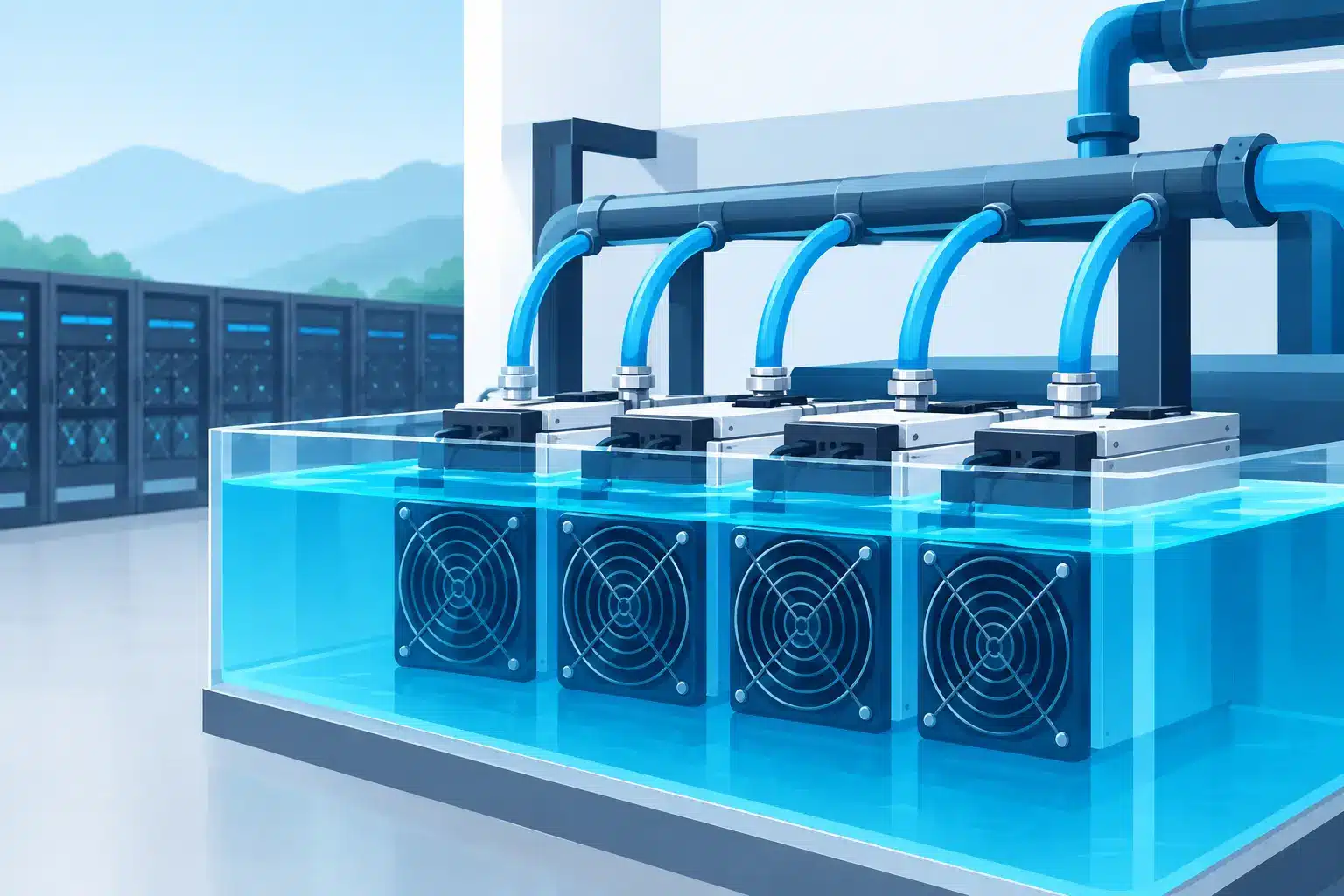
A hydro cooling case study is most useful when it deals with the operational question behind the hardware: can a mining fleet sustain high performance without heat, noise and maintenance eroding its economics? For a 200-unit ASIC deployment, the answer depends less on the miner’s headline hashrate than on the design of the cooling loop, electrical distribution, monitoring and support model around it.
This representative case examines how a growing Bitcoin mining operator assessed hydro cooling for a new fleet. The figures are illustrative rather than a guarantee of profitability. Mining returns still move with Bitcoin price, network difficulty, pool performance, machine efficiency and electricity cost. What the case demonstrates is where hydro cooling can create operational value, and where it may not be the right investment.
The operating challenge: 200 ASICs, one heat problem
The operator planned to deploy 200 latest-generation hydro ASIC miners. Each machine was expected to draw roughly 5.5 kW at its standard operating profile, creating an IT load near 1.1 MW. That load becomes heat. If the facility cannot remove it consistently, the fleet may throttle, generate more faults or require conservative operating settings that leave available hashrate unused.
Air-cooled machines were initially considered because the upfront infrastructure is familiar and easier to source. Yet the proposed site faced high ambient temperatures for part of the year, and the operator wanted room to increase performance settings later without rebuilding the entire cooling strategy. Noise was another practical consideration. Hundreds of high-speed fans create a significant acoustic burden, which can restrict site selection and increase the cost of sound treatment.
The decision was not simply hydro versus air. It was whether the higher initial capital expenditure for liquid cooling would produce enough benefit through stable operation, density and simpler fleet management over the planned operating period.
Hydro cooling case study: the proposed design
The design team specified a closed-loop water cooling system connected to the miners through supply and return manifolds. The facility included heat-rejection equipment sized for the expected IT load, pumps with redundancy, filtration, water treatment, leak detection, pressure and temperature sensors, and monitored valves at key points in the loop.
Hydro miners do not eliminate heat. They move it from thousands of small airflows into a controlled liquid circuit. That distinction matters. A well-designed system gives operators a clearer way to measure inlet temperature, outlet temperature, flow rate and pressure differential across each group of miners. When readings shift, the maintenance team can investigate a defined section of the loop rather than searching across a noisy room of fan-cooled units.
Electrical design was equally important. The 1.1 MW IT load was modelled alongside the cooling plant’s own consumption. Pumps and heat-rejection equipment add to the facility’s total power usage, so the operator evaluated both miner efficiency and site-level overhead. Hydro cooling can improve the thermal environment, but it is not free energy. The commercial model needed a transparent view of kWh pricing, cooling parasitic load and expected uptime.
Deployment plan and commissioning
The deployment was staged in four blocks of 50 machines. This reduced commissioning risk and gave the operations team time to validate flow balance, inlet temperatures and alarm thresholds before the full fleet went live.
Each block was pressure-tested before miners were connected. The team then flushed the loop, verified water quality, checked sensor calibration and inspected every hose and quick-connect fitting. Once machines were energised, performance was observed under normal load before moving to the next block.
This staged approach delayed the headline moment of having 200 units online, but it avoided a more expensive scenario: commissioning an entire fleet on an unproven loop and discovering a design fault under full thermal load. For mining infrastructure, fast deployment is valuable only when it is controlled. A provider that can commission quickly while documenting every system check gives the operator a stronger start.
What changed after hydro deployment
The first visible change was acoustic. Without the fan noise associated with a comparable air-cooled fleet, technicians could work in the mining area more comfortably and identify unusual pump or water-flow sounds earlier. Reduced noise is not just a convenience. It widens the range of viable industrial locations and can lower the need for additional acoustic mitigation.
The more meaningful change was thermal consistency. Instead of individual machines responding to uneven room temperatures, the fleet received controlled liquid inlet temperatures. Hashrate variation across machines narrowed once flow was balanced, making performance reports easier to interpret. If a group underperformed, engineers could compare its inlet temperature, return temperature and flow rate against the rest of the installation.
Maintenance also became more structured. Air-cooled operations often involve regular attention to fan performance, dust ingress and hot-spot behaviour. Hydro systems replace some of that work with different disciplines: checking fluid quality, inspecting connections, maintaining pumps and ensuring heat-rejection capacity remains available. The workload does not disappear. It becomes more centralised and measurable.
For this operator, centralisation was the point. A fleet of 200 machines is large enough that small, repeated service tasks can turn into a management issue. With 24/7 monitoring, alarms could be tied to temperature, pressure and flow conditions rather than waiting for a miner to reach a thermal fault state. The aim was to intervene before a fault became lost hashrate.
The economics: where the case was won or lost
The hydro design required more upfront spending than a basic air-cooled configuration. The budget had to account for hydro-compatible ASICs, piping, manifolds, pumps, heat-rejection equipment, controls, water treatment and specialist installation. It also required site engineering before delivery, because pipe routes, drainage, floor loading and electrical capacity cannot be treated as afterthoughts.
The operator did not justify that investment by claiming a guaranteed revenue uplift. Instead, the financial case used three operational levers: better performance stability in warm conditions, higher mining density per floor area, and fewer interruptions caused by thermal stress or fan-related issues. These benefits were compared with the additional Capex, cooling Opex and the cost of maintaining skilled site support.
The result was favourable because the operator intended to run the fleet at scale for an extended period and had a site where air cooling would have required substantial additional ventilation and noise controls. A smaller portfolio, a cool-climate location or a short-term operating plan could have produced a different result.
Hydro cooling is particularly compelling when power availability is valuable, space is constrained, ambient temperatures are challenging or the fleet is expected to grow. It is less compelling where an operator has inexpensive air-cooled space, modest heat density and no need for higher-performance operating profiles.
Risks that had to be designed out
Liquid near ASIC hardware demands discipline. The project treated leak prevention and detection as core infrastructure, not optional extras. Connections were selected for serviceability, lines were labelled, leak sensors were installed in critical areas, and technicians followed a documented isolation procedure before replacing a unit.
Redundancy also had commercial value. A single pump failure should not force a large section of the fleet offline. The system therefore included duty and standby capacity, with alarms routed to the operations team. Heat rejection received the same attention. If outdoor conditions rise or a component loses capacity, the site needs sufficient headroom to avoid a rapid temperature escalation.
Water quality was another non-negotiable. Poorly managed fluid can cause corrosion, scaling or blockages that gradually reduce performance. Routine testing and treatment are not glamorous, but they protect expensive hardware and prevent avoidable downtime.
What mining operators should ask before choosing hydro
Before committing to a hydro fleet, operators should request a site-specific model rather than relying on headline claims. It should show IT load, cooling overhead, expected inlet temperatures, redundancy assumptions, maintenance scope, deployment timeline and the commercial treatment of electricity. If a host is managing the facility, clarify who owns each responsibility when a fault occurs and how quickly the team responds.
Ask whether the provider can source compatible hardware, install the cooling infrastructure, monitor the fleet and carry out repairs under one accountable operating model. Fragmented responsibility can turn a straightforward technical issue into a dispute between hardware supplier, installer and host. BitHash approaches hydro hosting as an infrastructure operation, combining deployment, monitoring and maintenance rather than leaving the client to coordinate separate parties.
The strongest hydro cooling projects begin with the operating plan, not the equipment catalogue. Model the intended fleet size, power contract, heat load, growth path and acceptable downtime before selecting machines. When those variables are aligned, liquid cooling can turn a difficult thermal constraint into a controlled part of a high-performance mining operation.
Written by BitHash Editorial
BitHash Infrastructure & Mining Research Team